
Readings: Various (NIVUK)
Where:
Minister: Brent Richardson
Matthew 13:18-23 (NIVUK)
18 ‘Listen then to what the parable of the sower means: 19 when anyone hears the message about the kingdom and does not understand it, the evil one comes and snatches away what was sown in their heart. This is the seed sown along the path. 20 The seed falling on rocky ground refers to someone who hears the word and at once receives it with joy. 21 But since they have no root, they last only a short time. When trouble or persecution comes because of the word, they quickly fall away. 22 The seed falling among the thorns refers to someone who hears the word, but the worries of this life and the deceitfulness of wealth choke the word, making it unfruitful. 23 But the seed falling on good soil refers to someone who hears the word and understands it. This is the one who produces a crop, yielding a hundred, sixty or thirty times what was sown.’
1 Corinthians 3:6-9 (NIVUK)
6 I planted the seed, Apollos watered it, but God has been making it grow. 7 So neither the one who plants nor the one who waters is anything, but only God, who makes things grow. 8 The one who plants and the one who waters have one purpose, and they will each be rewarded according to their own labour. 9 For we are fellow workers in God’s service; you are God’s field, God’s building.
Psalm 1
1 Blessed is the one
who does not walk in step with the wicked
or stand in the way that sinners take
or sit in the company of mockers,
2 but whose delight is in the law of the Lord,
and who meditates on his law day and night.
3 That person is like a tree planted by streams of water,
which yields its fruit in season
and whose leaf does not wither –
whatever they do prospers.
4 Not so the wicked!
They are like chaff
that the wind blows away.
5 Therefore the wicked will not stand in the judgment,
nor sinners in the assembly of the righteous.
6 For the Lord watches over the way of the righteous,
but the way of the wicked leads to destruction.
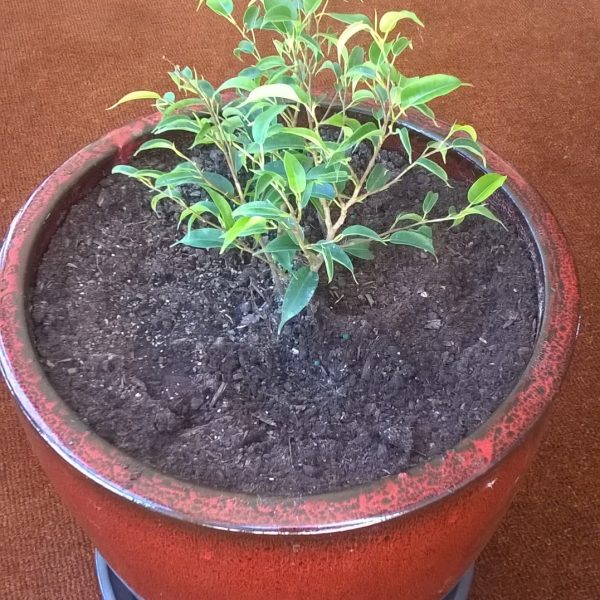
(P) We’ve titled our summer series ‘Growing in God’ and we will be using the metaphor of a living house plant to draw out important themes to this growth. We will be planting an indoor plant that will live in our foyer and be a constant reminder of these themes as we watch it grow and develop.
Over the next 4 weeks we will look at the key elements in sustaining a healthy house plant- the container, the soil, the plant and then the ongoing nurture. And hopefully we will learn what we need in our lives to grow as healthy, fruitful Christians. The series will be recorded and available on our website so you can listen to the whole thing even if you miss a Sunday.
It may be stating the obvious but I think I need to: the Christian life carries with it the expectation to grow in God. Our readings this morning point to this reality using the metaphor of growing plants. Seeds planted by God grow and produce crops. Trees planted by streams produce fruit in their season because they are watered by God’s goodness.
But plants can also be stunted in their growth, unfruitful, growing in the wrong way or in the wrong place. Every gardener knows the scourge of weeds and the need to be always dealing with these unwanted species in our gardens. Likewise, as Christians we can be stunted, deformed, unfruitful. We can attract weeds into our lives that will take over if we let them.
The end goal of this growth in God is described for us in Ephesian 4:11-16 (P)
11 So Christ himself gave the apostles, the prophets, the evangelists, the pastors and teachers, 12 to equip his people for works of service, so that the body of Christ may be built up 13 until we all reach unity in the faith and in the knowledge of the Son of God and become mature, attaining to the whole measure of the fullness of Christ.
(P) 14 Then we will no longer be infants, tossed back and forth by the waves, and blown here and there by every wind of teaching and by the cunning and craftiness of people in their deceitful scheming. 15 Instead, speaking the truth in love, we will grow to become in every respect the mature body of him who is the head, that is, Christ. 16 From him the whole body, joined and held together by every supporting ligament, grows and builds itself up in love, as each part does its work.
So, what does it take to grow in God?
Firstly, we need a container. For our foyer plant we need a good pot to grow it in. Obviously if we tried to grow an indoor plant in a pile of soil it wouldn’t work. As soon as we watered it the soil would go everywhere and we’d have a mess. The roots would become exposed and would fail to access any nutrients and the plant would die. So, the container is pretty important!
What is the container for our faith? Or, to put it another way, what supports our faith and helps us grow in God?
Ask the congregation for suggestions and write these on a whiteboard.
I think the first and most obvious container is scripture. St Paul places high value on scripture and charges his young pastor protégé Timothy: (P)
1 Timothy 4:13 (NIVUK)
13 Until I come, devote yourself to the public reading of Scripture, to preaching and to teaching.
2 Timothy 3:16-17 (NIVUK)
16 All Scripture is God-breathed and is useful for teaching, rebuking, correcting and training in righteousness, 17 so that the servant of God[a]may be thoroughly equipped for every good work.
The main thing that scripture does is to inform us about God’s dealing with humanity, firstly through his chosen people Israel and culminating in Jesus, who, as the ‘word made flesh’, is the ultimate revelation of God and his clearest word to us. All of the New Testament is the testimony of people who encountered Jesus in the flesh, followed him and were transformed by him. The epistles basically describe and give instruction to believers about what following Jesus (or growing in God) looks like.
Without the scriptures, the Christian is very weak indeed. This was the state of Christianity in medieval Europe. Bibles were kept under lock and key in cathedrals, Abby’s and monasteries. Only the educated clergy could read them. Which gave the clergy a great deal of power over common folk, and as we all know, power corrupts.
It took the Reformation to break this power and the invention of the printing press to put scriptures in the hands of ordinary people. Once this happened there was an explosion of growth in Christian mission and personal devotion (seen in such movements as the Puritans, Anabaptist, Presbyterian and Lutheran churches).
The remarkable thing about the bible is its ability to speak to every generation and every culture. It can be tempting to think that these ancient writings could have nothing relevant to say to us living in this technologically advanced information age. And yet the basic human condition remains the same. We still hate, fight and make war; we still long for meaning and purpose and true love. We still need something bigger than ourselves to believe in. We still need (more than ever) something to guide our lives that is not of our own making.
Another container for our faith that helps us grow in God is the gathered community of believers, aka going church. The simple practice of regularly turning up for worship services has a profound effect on Christian growth. This is because it puts us in contact with other important containers for faith- scriptures and the teaching/preaching from these, prayer and worship.
Of course, these things don’t just happen at church- you can listen to bible teaching on TV, you can pray by yourself (and we are encouraged to do so) and you can worship by yourself. But will you? I’ve met many people who were once regular church goers who decide to step out and do their own thing. They usually have ‘good’ reasons for this:
“I’m just not getting anything out of church anymore”
“I feel closer to God when I’m out fishing- that’s my worship”
“My life is so stressed and busy I don’t have time for church”
“Church is taking up family time which is important to me”
“My church got demolished after the earthquakes so I have nowhere to go”
And so it goes on. The result is their faith usually withers. If you remove a branch from a grape vine the vine continues to live but the branch doesn’t. Likewise, if you remove a coal from a fire the fire continues but the coal dies so that it no longer produces heat and light. Just black coal with unrealized potential.
Aside from prayer, worship and hearing the word preached coming to church does something that the alternatives can’t. It provides us with fellowship and opportunities to learn off others and even be challenged by different ideas or exposed to situations that will test our character.
If you only listen to TV preachers will you allow yourself to be challenged or will you take the easy option and change channels? When we belong to a church there is always a risk that someone will do or say something that will offend you. What will you do? Leave in a huff? Tell a whole lot of other people? Ask the pastor to sort it out? Or go to the person and deal with it in a mature responsible way? Being in a community of faith gives us the opportunity to grow in Christ-like character.
For faith to grow, for our lives to be fruitful in God we need a container. The local church is the container. We will grow according to the container we’re in. For example, if the container is too small it will restrict the growth of the plant. Some churches are very tight on doctrine and are very clear about right and wrong and leave know room for questions or discussion. Result- stunted Christians who can’t think for themselves. At the other end the container might be so big as to provide no boundaries. Result- wild and untamed plant that produces little fruit.
Every gardener or farmer knows it takes more than throwing some seed around to produce a crop. It takes care, attention, vigilance, work, effort, inputs, pruning etc. To grow in God is likewise and intentional thing- it doesn’t happen by itself. So, as we move into a new year may we be intentional about our spiritual growth. Ask yourself; in what ways do I need to grow as a Christian? What one thing could I begin to do that will aid this growth?
Amen
