
Readings: Isaiah 40:21-31 (NIVUK)
Where: Trinity, College Road, 4 February 2018
Minister: Brent Richardson
21 Do you not know?
Have you not heard?
Has it not been told you from the beginning?
Have you not understood since the earth was founded?
22 He sits enthroned above the circle of the earth,
and its people are like grasshoppers.
He stretches out the heavens like a canopy,
and spreads them out like a tent to live in.
23 He brings princes to naught
and reduces the rulers of this world to nothing.
24 No sooner are they planted,
no sooner are they sown,
no sooner do they take root in the ground,
than he blows on them and they wither,
and a whirlwind sweeps them away like chaff.
25 ‘To whom will you compare me?
Or who is my equal?’ says the Holy One.
26 Lift up your eyes and look to the heavens:
who created all these?
He who brings out the starry host one by one
and calls forth each of them by name.
Because of his great power and mighty strength,
not one of them is missing.
27 Why do you complain, Jacob?
Why do you say, Israel,
‘My way is hidden from the Lord;
my cause is disregarded by my God’?
28 Do you not know?
Have you not heard?
The Lord is the everlasting God,
the Creator of the ends of the earth.
He will not grow tired or weary,
and his understanding no one can fathom.
29 He gives strength to the weary
and increases the power of the weak.
30 Even youths grow tired and weary,
and young men stumble and fall;
31 but those who hope in the Lord
will renew their strength.
They will soar on wings like eagles;
they will run and not grow weary,
they will walk and not be faint.
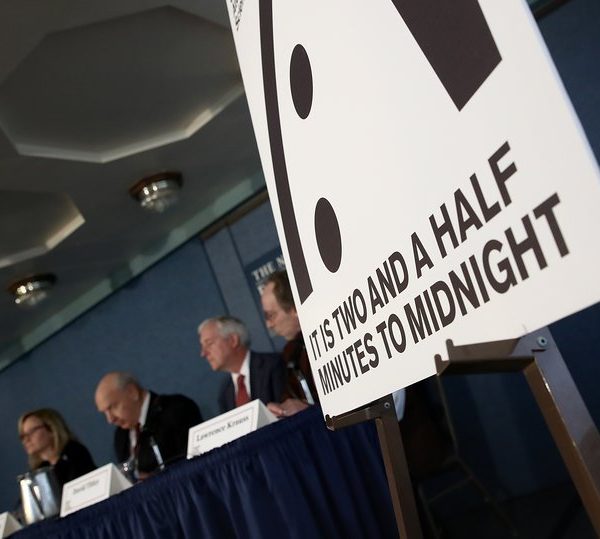
(P) It was reported last week that the Bulletin of Atomic Scientist have moved the Doomsday clock 30 seconds closer to midnight. The Doomsday clock was conceived in 1947 to track the worlds vulnerability to the threat of global nuclear war and it was initially set to 7 minutes to midnight. It’s now at 2 minutes, the closest it’s ever been.
The scientist are saying the world is as dangerous right now as it was just prior to the out-break of WWII! Trump’s repeated threats of war on North Korea, political instability in many places and the refusal to tackle the causes of climate change, especially by the US, are the main reasons cited.
We are living in anxious and uncertain times.
So the words from Isaiah today are very relevant to us and provide us with that most essential ingredient for life; hope. These words were written for an exiled people who God was calling back to their promised land. But they had lived in this foreign land of Babylon for 70 years, struggling to maintain their culture and identity. During this time 2 questions plagued them;
Was their God, Yahweh, not strong enough to defeat the god’s of Babylon?
Had God simply abandoned them and given them up?
The prophet’s spoke into these questions affirming over and over again that God was in deed stronger than all so called gods and that he hadn’t forgotten his people.
These same questions may be close to the surface of our own hearts. We live in times when the Church exists on the margins of society, no longer in the cultural driver’s seat as it once was. (P) We saw further proof of this last week when the Speaker of the House (Trevour Mallard) removed ‘Jesus Christ’ from the prayer that opens Parliament. It’s one thing to speak about God in general, generic terms but bringing Jesus in makes things very specific. This is too much for a pluralistic society.
We live in a world where the God we love and worship is mostly ignored. People aren’t exactly falling over themselves to get to church! Many seem content to live their lives without reference, respect or responsibility to God, choosing to believe God is just something our forebears, in their ignorance, believed in.
(P) Into this the prophet speaks: “Do you not know? Have you not heard? Has it not been told you from the beginning?” This is a call to the people to return to the faith they once had in God. Why should they do this? Because God is enthroned above the earth; he is over every ruler and system that dominates his people, he orders the cosmos. In spite of his greatness, he is closely and intimately connected to his people, renewing their strength and caring for them.
Do you not know? Have you not heard? God is enthroned above the earth. The image here is that God is so far above us that we look like grasshoppers to him. This is a picture of scale; a grasshopper at my feet is very small in relation to me in the same way that we are tiny, insignificant even, when compared to the grandeur of God. More than that, even the heavens, which are vast beyond all measure, he spreads out like a tent. Perhaps this is an allusion to the routine task of Nomads erecting a shelter in the desert. God is so great that keeping the universe spinning is just a routine task.
(P) “He brings princes to naught and reduces the rulers of this world to nothing”. In democratic societies like ours we are accustomed to having periodic changes in governments. We don’t expect to live our whole lives under the same government. But this is a relatively new phenomenon and in many parts of the world tyrannical leaders are very entrenched.
(P) Speaking to someone from Zimbabwe once I commented that surely Mugabe couldn’t remain in power much longer- he was so old for one thing. That was 10 years ago! It seemed like nothing-not even death- would shift him. Mercifully, last year he resigned and is now consigned to history. The principalities and powers that oppress the people of God may seem permanent, but our God is greater still and to him they are mere chaff (v24).
(P) “To whom will you compare me? Or who is my equal? Says the Holy One”.
God is always inviting us outside at night to consider the stars and what these teach us about him. Theologians call this general revelation- the things that can be known about God revealed in the created order (see Rom 1:19). For example, Abraham was told to count the stars if he could and that would be the number of his descendants. Joseph had a dream of the moon and stars bowing down to him.
(P) When was the last time you sat outside at night and contemplated the stars? Nowadays it’s not so easy to do. We live with ubiquitous light pollution (unless you live a long way from the city). And we are distracted by other pursuits made possible by electric power. But for millennia sitting underneath the stars, telling stories, wondering how far away they were and how they came to be was probably a nightly occurrence.
If you only had the stars, what might you learn about God? Perhaps you would notice there is an incredible orderliness to them (even though they look like a random scattering). There are patterns which move with predictable regularity and rhythm. So much so that you can navigate your way across featureless oceans for 1000’s km! You would notice the vast number of stars and perhaps suspect there are even more beyond your limited vision. How powerful, how awesome must be the god who can create all this!
The Hebrew God is presented as the creator of all and stands in stark contrast to the alternative ancient gods who were limited to territory or to specific parts of creation. God’s of water, sky, love, war, lightening etc. But these gods are too small. Isaiah is saying that the God of the Hebrews, Yahweh, the Lord stands supreme and unchallenged.
But the modern secular world rejects all this, disposing of all gods including the Christian/Jewish/Muslim one and consigning them to irrelevancy. Perhaps because of the sophistication of our knowledge of how things work we no longer think God has a place. Many assume evolutionary science has erased the need for God. It hasn’t. Science is brilliant on explaining the ‘how’ but not so good on the ‘why’. Why does any of this exist? Why do we derive so much pleasure from the beauty of a sunset?
And who will be there for us when our world falls apart? When we can no longer fix the mess we’ve made? This is the most whimsical part of Isaiah’s message. As vast as God is; high above us and all of creation- he is intimately involved in the lives of his people. Theologians call this the transcendence and imminence of God. God is both high above but choses to limit himself in his creation by incarnating in Christ and dwelling within his people by his Holy Spirit.
(P) “Why do you complain, Jacob? Why do you say Israel ‘My way is hidden from the Lord; my cause is disregarded by my God?'” Is God too weak or forgetful to help his people in their time of trouble? Are you facing things that are wearing you down? Sapping your strength and hope? Life can be very tough; it can grind us down, steal our joy and rob us of faith.
The exiled Jews understood this. They faced an uncertain future- just like us. They had little strength to go on. And they weren’t going back to a country in good order. They were going back to rebuild a shattered city. That would take strength and resolve. When I think about the future we face- the challenges before us to rebuild and renew our church and to connect with our community in mission- I realize that we will need strength and resolve also.
But where do we get that? I hear it all the time: we need more young people with energy to carry the work of the church forward. True. But even youths grow tired and weary! What we really need is to learn to renew our strength in the Lord.
(P) But those who hope in the Lord will renew their strength. They will soar on wings like eagles.
The picture here is actually of a molting eagle shedding its feathers so new strong ones can come through. God calls us to exchange our weakness for his strength. We do this through keeping our hope in the Lord. What does that mean? It means we look forward in hope to God’s future rather than being fixated on what might or might not happen. Remember, God holds our past, present and future in his hands. It is to live with the expectation that God will keep his promises to you, which is for a glorious future in Christ.
May our hope and faith remain fixated on God who is above all, in all and through all.
Amen
